Most taxi and ride-hailing companies don’t fail because of bad technology. They fail because no one knows they exist. In a market shaped by players like Uber, demand is no longer something that “just happens.” It’s engineered. Built. Optimized. Repeated.
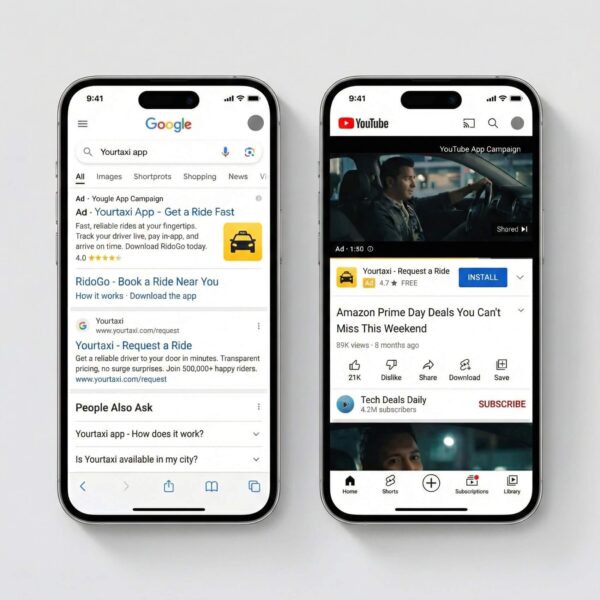
Yet many operators still treat marketing as something secondary – something to figure out after the launch, after the fleet is ready, after drivers are onboarded. By then, it’s already too late.
A common pattern we see is this: a company launches with a functional product, maybe even a solid operational setup, but without a clear brand or acquisition strategy. A few campaigns are tested, some budget is spent across different channels, but nothing is consistent. There is no clear positioning, no defined audience, and no system to measure what actually works.
The result is predictable. Growth is slow, utilization stays low, and pressure starts to build. At that point, marketing becomes reactive – driven by urgency rather than strategy. Discounts increase, experiments multiply, and costs rise faster than revenue.
This is where many businesses lose control of their unit economics.
Why Bad Marketing Happens
Poor marketing rarely comes from a lack of effort. It usually comes from wrong priorities. Many operators believe they have more urgent problems to solve – fleet, drivers, operations – and that marketing can wait. It feels logical in the short term, but in reality it’s a short-sighted decision that creates much bigger problems later.
Another common issue is lack of direction. Marketing activities exist, but they are scattered and unstructured. There is no clear target audience, no defined positioning, and no consistent brand language. Without that foundation, even well-funded campaigns struggle to deliver results.
This is where the gap between smaller operators and companies like Uber becomes obvious. The difference is not just budget – it’s clarity. They know exactly who they target, how they communicate, and how they measure success.
Without that clarity, marketing becomes noise. And noise doesn’t convert.
When Marketing is Treated as Optional
In early stages, many companies treat marketing as a “nice to have.” Budgets are allocated to everything else first, and whatever remains is used for promotion – if anything is left at all. The assumption is simple: launch first, invest in marketing later.
The same thinking often leads to another mistake – launching with a weak or non-existent brand. A generic app, no clear identity, no differentiation. It may save money initially, but it creates a much bigger problem: people don’t remember you, and you can’t build demand around something that has no identity.
At some point, reality catches up. Growth is slower than expected, revenues don’t match projections, and pressure builds. That’s when companies switch into reactive mode. Marketing becomes urgent instead of strategic. Discounts increase. Random campaigns are launched. Budgets are spent faster, but results don’t improve. Panic replaces planning – and panic-driven marketing almost never works.
How to Build a Marketing System That Actually Works
Forget random marketing. It doesn’t scale. If you want predictable growth, start here:
- Map all key marketing activities needed to generate demand (which 2-3 channels you will use to attract users?)
- Define your target audience and core differentiation (how you are different from others?)
- Set a realistic marketing budget upfront
- Work with professionals who understand mobility (execution matters)
- Focus on a few channels that actually convert
- Track core KPIs: installs → first ride → retention
- Continuously adjust based on real data, not assumptions
The earlier you build this system, the faster you reach profitability.
How Atom Mobility Helps Operators Grow
At ATOM Mobility, we’ve seen this dynamic across hundreds of mobility businesses globally. The difference between those who scale and those who stall rarely comes down to technology alone. Execution is what separates them.
That’s also why we expanded beyond software and, together with industry experts, launched a dedicated marketing service to support operators directly.
We help mobility businesses go from zero to scalable demand – covering go-to-market strategy, branding, performance marketing, app store optimization, and continuous growth management, all tailored specifically for ride-hailing and taxi operators.
👉 Learn more and see how we can support your growth:
https://www.atommobility.com/marketing-agency
This article was originally published by ATOM Mobility.