Delhi has long been at the forefront of India’s electric mobility transition. Its EV policy has set the pace for the rest of the country- driving adoption, incentivising consumers, and building early infrastructure. By many measures, it has been a success.
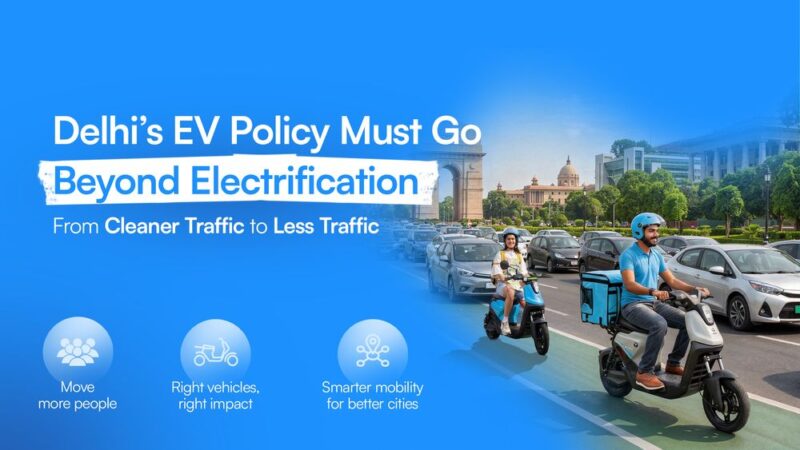
But as the city prepares for the next phase of its EV journey, it is worth asking a more fundamental question: what problem are we really trying to solve?
If the answer is air pollution and emissions, electrification is essential. But if the answer also includes congestion, commute times, and the overall efficiency of urban mobility, then electrification alone is not enough.
Because the uncomfortable truth is this: an electric traffic jam is still a traffic jam.
Try Yulu today! Download the Yulu app for Android or iOS.
The Limits of Electrification
The current EV narrative, both in policy and public discourse, largely equates progress with the number of electric vehicles on the road. More registrations, more subsidies, more charging stations. These are important milestones, but they risk becoming ends in themselves.
If every internal combustion engine vehicle in Delhi were replaced overnight with an electric one, the city would certainly be cleaner. But it would not move any faster. Roads would remain clogged, commute times would remain long, and the economic cost of congestion would persist.
In other words, we would have solved one problem while leaving another largely untouched.
Rethinking What Success Looks Like
To truly unlock the potential of electric mobility, we need to shift from measuring adoption to measuring impact.
Instead of asking, “How many EVs are on the road?”, we should be asking:
How many kilometres have been electrified?
How much carbon emissions been avoided?
How efficiently are people being moved across the city?
These are harder questions, but they are the ones that matter.
Not all EVs deliver the same outcomes. A privately owned electric car that is used for a couple of short trips a day has a vastly different impact compared to a shared electric vehicle that operates throughout the day, serving multiple users across dozens of trips.
The difference lies in utilisation, efficiency, and road space.
Why Smaller, Shared EVs Matter More
Delhi’s roads are a finite resource. Every additional vehicle – electric or otherwise – competes for the same limited space. This is where the form factor of mobility becomes as important as the fuel that powers it.
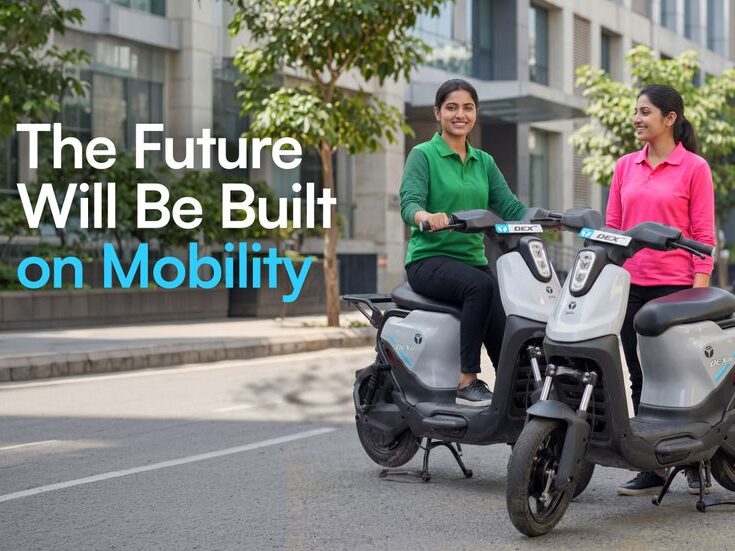
Light, shared electric vehicles, such as low-speed two-wheelers, offer a fundamentally different proposition. They are designed for short urban trips, occupy a fraction of the road space, and can be used by multiple riders over the course of a day.
This creates a multiplier effect. One such vehicle can replace several short car trips, reduce congestion at bottlenecks, and deliver significantly higher emissions savings per kilometre of road space used.
Simply put, the cleanest vehicle is not just electric; it is the one that is used the most, by the most people, using the least space.
At Yulu, our experience across cities shows that a majority of urban trips are short-distance in nature: precisely the journeys that can be most efficiently served by compact, shared EVs. When these trips shift away from larger vehicles, the benefits are visible not just in emissions data, but in smoother traffic flow.
Congestion and Climate Are the Same Problem
It is tempting to think of congestion and emissions as separate challenges. In reality, they are deeply interconnected.
Stop-and-go traffic increases energy consumption and reduces overall efficiency. Vehicles stuck in congestion – whether electric or conventional – contribute to a system that wastes time, energy, and productivity. Conversely, when traffic flows more smoothly, the same road network can move more people with lower energy per trip.
This is why solving congestion is not just an urban planning goal. It is a climate imperative.
Delhi’s EV policy has already made important strides in reducing tailpipe emissions. The next step is to ensure that these gains are amplified by improving how the city moves.
A Shift in Policy Thinking
For this to happen, policy must evolve from a focus on ownership to utilisation, and from vehicles to systems.
First, there is a need to actively incentivise high-utilisation EVs, particularly those deployed in shared mobility and last-mile logistics. These vehicles deliver disproportionate benefits in terms of emissions reduction and road efficiency.
Second, cities must prioritise smaller-format mobility solutions. Low-speed EVs and micromobility options are uniquely suited to dense urban environments like Delhi, where short trips dominate and space is at a premium.
Third, success metrics must be redefined. Alongside adoption numbers, policymakers should track indicators such as emissions avoided, trips electrified, and modal shifts from private to shared transport.
Finally, integration is key. Electric mobility cannot operate in silos. It must work in tandem with public transport, bridging first- and last-mile gaps and enabling seamless, multimodal journeys.
The Road Ahead
Delhi has already demonstrated what strong policy intent can achieve. It has accelerated EV adoption and sparked a nationwide shift toward cleaner mobility. But the next phase demands a broader vision.
The goal should not be just to replace petrol vehicles with electric ones, but to reimagine how mobility itself is delivered: making it cleaner, more efficient, and more accessible.
Because in the end, the future of urban mobility will not be defined by how many vehicles we electrify, but by how effectively we move people.
Delhi has the opportunity to lead this transition- not just toward electric mobility, but toward better mobility.
And that is a journey worth accelerating.
This article was originally published by Yulu.