Building a shared mobility platform in India teaches you one thing very quickly. Indian cities are living, unpredictable systems.
Roads change overnight. Traffic flows reverse during peak hours. Riders take shortcuts. Delivery demand spikes unexpectedly at different times of the day or during certain seasons. And users interact with mobility very differently across every neighbourhood.

For Yulu, building a successful mobility platform meant learning from these realities early and tackling these problems head on. And over the years, several small but significant innovations have helped Yulu make shared mobility work reliably in India.
Try Yulu today! Download the Yulu app for Android or iOS.
Designing EVs for Indian Roads
An insight Yulu learned early was that vehicles designed for ideal road conditions often struggle in Indian cities.
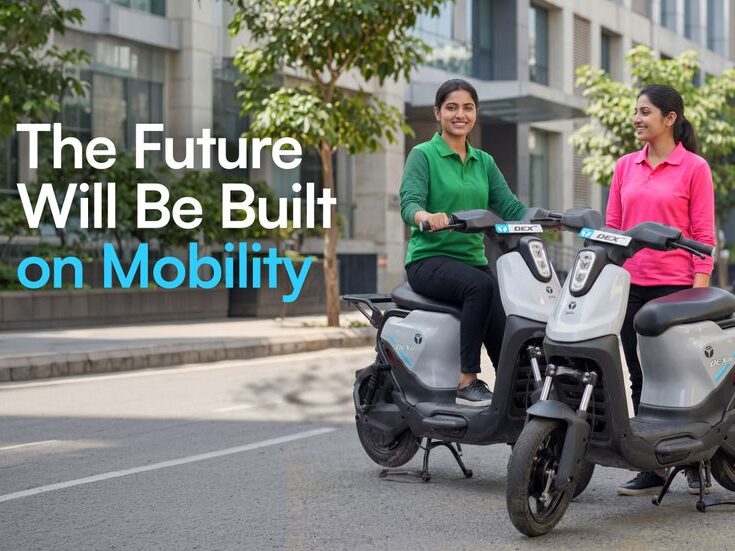
Hence, small design decisions mattered enormously. Yulu’s vehicles were continuously refined based on real rider feedback and on-ground usage patterns from Indian cities. Features like a lightweight frame and tighter turning radius helped riders navigate dense traffic and narrow lanes more easily, while the riding posture and vehicle balance were optimised to reduce fatigue for delivery executives spending 10 to 12 hours on the road every day.
The vehicles were also designed to handle frequent stop-start movement, uneven roads and potholes that are common across Indian cities. Practical additions like easy battery accessibility and delivery-friendly load carrying capability further ensured that the vehicles worked reliably in high-utilisation urban conditions, not just controlled testing environments.
Solving for Parking Chaos
Another major challenge was parking.
Unlike cities in Europe or Singapore, most Indian urban environments do not have structured parking infrastructure designed for dockless mobility systems. Vehicles parked carelessly can quickly create friction with pedestrians, local authorities and residents.
In the early days, ensuring that vehicles were parked responsibly while still keeping the experience convenient for users became a difficult balancing act.
This led Yulu to develop a near-field communication (NFC)-based parking system and designated Yulu Zones. The idea was practical. Riders could securely end rides only at validated parking zones using NFC technology, where sensors in the vehicle and the designated parking zone in our systems communicate with each other to verify that the vehicle has been parked in the correct location before the ride can be ended on the app. This helped maintain parking discipline, improve asset security and ensure better vehicle availability across the network.
Most importantly, it allowed Yulu to scale shared mobility in important public and high footfall locations without requiring expensive physical infrastructure.
Tackling Range Anxiety
When Yulu began expanding into delivery use cases, another challenge became clear very quickly.
Delivery executives were covering 70-100 kilometres daily across food delivery and quick commerce platforms. Traditional EV charging models simply did not work for such high-utilisation usage, because waiting several hours to charge a vehicle meant lost income for riders.
Therefore, instead of treating charging as an isolated problem, Yulu approached it as an uptime challenge. This thinking led to the creation of a deeply integrated battery swapping ecosystem with Yuma Energy, a joint venture of Yulu and Magna International.
But even battery swapping came with its own complexities: e.g., How do riders know which Yuma station to go to for their next battery swap? And how can Yulu prevent swap station overcrowding?
To solve these challenges, Yulu gradually introduced a token-based battery swap reservation system. Under this system, riders could view the number of available batteries at the nearest Yuma stations by opening the Yulu app. This made them more confident of being able to get a fresh battery whenever they needed one, and to do their jobs with minimal downtime. Today, riders are typically able to complete a battery swap in under two minutes.
Wrong-Side Ride Detection
One of the earliest operational issues Yulu encountered was something deeply familiar to anyone who has spent time on the road: wrong-side riding.
In many Indian cities, drivers often take the wrong side of the road for short distances to save time or avoid long U-turns. This behaviour occurs across every vehicle category and is a known road safety hazard. However, when it comes to shared mobility, it is also an operational challenge, since it results in rider safety risks, complaints from pedestrians and local residents, and difficulty maintaining disciplined ride behaviour at scale.
For Yulu, the easy response would have been to simply issue warnings inside the app. But errant behaviour on the roads is rarely corrected through notifications alone.
Therefore, Yulu came up with a Wrong-Way Ride Detection feature. Yulu built this feature using IoT technology, geospatial indexing, and real-time GPS tracking to detect when riders go against the direction of traffic. Errant behaviour was promptly detected and warnings and penalties issued.
Combined with rider education, operational nudges and system-level interventions, the wrong-way ride detection technology has helped Yulu to positively transform rider behaviour in several hotspots.
Building for India Means Building for Complexity
Perhaps the biggest misconception about mobility is that scale comes from adding more vehicles.
In reality, scale comes from reducing friction.
Every challenge Yulu solved, whether it was parking discipline, wrong-side riding, charging downtime or vehicle design, removed one more layer of friction from the urban mobility experience. Having enabled more than 2 billion kilometres of rides, Yulu’s biggest advantage today is not just its vehicles. It is its ability to build an EV playbook for India that is on par with the best in the world.
This article was originally published by Yulu.