Journey planning and disruption management are usually treated as two separate problems. Planning is what happens before you leave: the route, the modes, the timing. Disruption management is what happens when something goes wrong en route: the alert, the apology, the scramble to figure out what to do next.

But this separation is artificial, and it is increasingly the source of a fundamental failure in how transport systems serve passengers.
A journey plan is not a static document. It is a set of assumptions about the world: that a bus will arrive on time, that a connection will hold, that the route available at 8am will still be valid at 8.15. When those assumptions break down, passengers do not need a new notification. They need a new plan. And right now, most systems are built to deliver the former while leaving passengers to improvise the latter.
This is not an abstract technology problem. It is a direct challenge to the quality and reputation of the transport services provided to residents, many of whom have no alternative way to travel.
The gap between alerting and helping
The past decade has brought real progress in real-time transit information. Passengers can now receive live departure updates, service status pages have become standard, and app-based alerts mean that disruptions reach users faster than ever. This is genuinely useful. But it addresses only half of the problem.
Knowing that a bus is delayed by 22 minutes does not tell a passenger whether they will still make their onward connection. It does not suggest an alternative route. It does not account for the fact that they use a wheelchair, or that they are travelling with young children, or that the next service on their route does not run for another hour. The information is accurate. The help is absent.
For councils and operators responsible for connecting residents to employment, healthcare and essential services, this gap has real consequences. Missed appointments, reduced workforce participation and social isolation are among the negative outcomes of failing transport systems.
Why rerouting alone is not enough
Journey planning platforms can already offer dynamic rerouting, automatically generating alternative routes when a service is disrupted. This is a significant step forward from static alerts, and the underlying routing logic is sophisticated. But even smart rerouting still operates on a system-centric model: it responds to network events, not to individual passenger situations.
The alternative route it suggests may be faster on average. But does it account for the specific passenger’s saved accessibility preferences? Does it reflect the fact that they are mid-journey rather than at their origin? Does it know they have already purchased a ticket for the disrupted service and need a valid alternative?
These are not edge cases. They are the normal texture of real journeys, which require a different kind of intelligence: not just a routing engine that knows the network, but a system that understands context.
The conversational turn
This is where AI changes the equation, but only if it is built correctly.
General-purpose AI assistants can already hold a conversation about travel. Ask one how to get across a city by public transport and it will give a plausible-sounding answer. But plausible is not the same as accurate. AI models trained on general data cannot reliably access live schedules, real-time disruptions, or current network conditions. They are liable to suggest stops that do not exist, routes that no longer run, or connections that are no longer possible. For casual exploration, that is inconvenient. For a resident trying to reach a hospital appointment, it is a failure.
The key architectural insight is that conversational AI needs to be grounded in verified, real-time routing data to be genuinely useful in a transport context. The language model provides the interface: the ability to understand natural questions, interpret intent, and respond in plain language. The routing engine provides the substance: the live network data, the multimodal options, the accessibility flags, the disruption feeds. Neither is sufficient alone.
This is the foundation of TripGo Mobility AI, SkedGo’s AI-powered capability that combines large language model reasoning with the verified, real-time TripGo multimodal routing engine. Rather than having a language model guess at travel options, TripGo Mobility AI uses the Model Context Protocol (MCP) to give AI assistants, including Claude, ChatGPT and others, direct access to live journey planning tools. When a passenger asks a question, the AI does not generate an answer from training data. It calls the routing engine, retrieves current conditions, and responds with results that are accurate, explainable and grounded in what is actually happening on the network right now.
The result is something qualitatively different from both traditional rerouting and general AI chat: a system that can understand what a passenger is trying to achieve, access live data to assess what is possible, and explain the options in plain language, the way a knowledgeable human assistant would.
What this looks like during disruption
Consider three scenarios that illustrate how conversational journey intelligence changes the disruption experience.
A commuter is on a train that is held between stations due to a signal failure. Their usual connection at the next interchange gives them four minutes, already tight and now impossible. Rather than receiving a generic service alert, they ask their journey assistant what to do. The system knows their destination, their accessibility requirements and their current position. It checks the live network, calculates that the connection is lost, identifies an alternative with a validated step-free route, and explains the options clearly. The passenger makes an informed decision in under a minute.
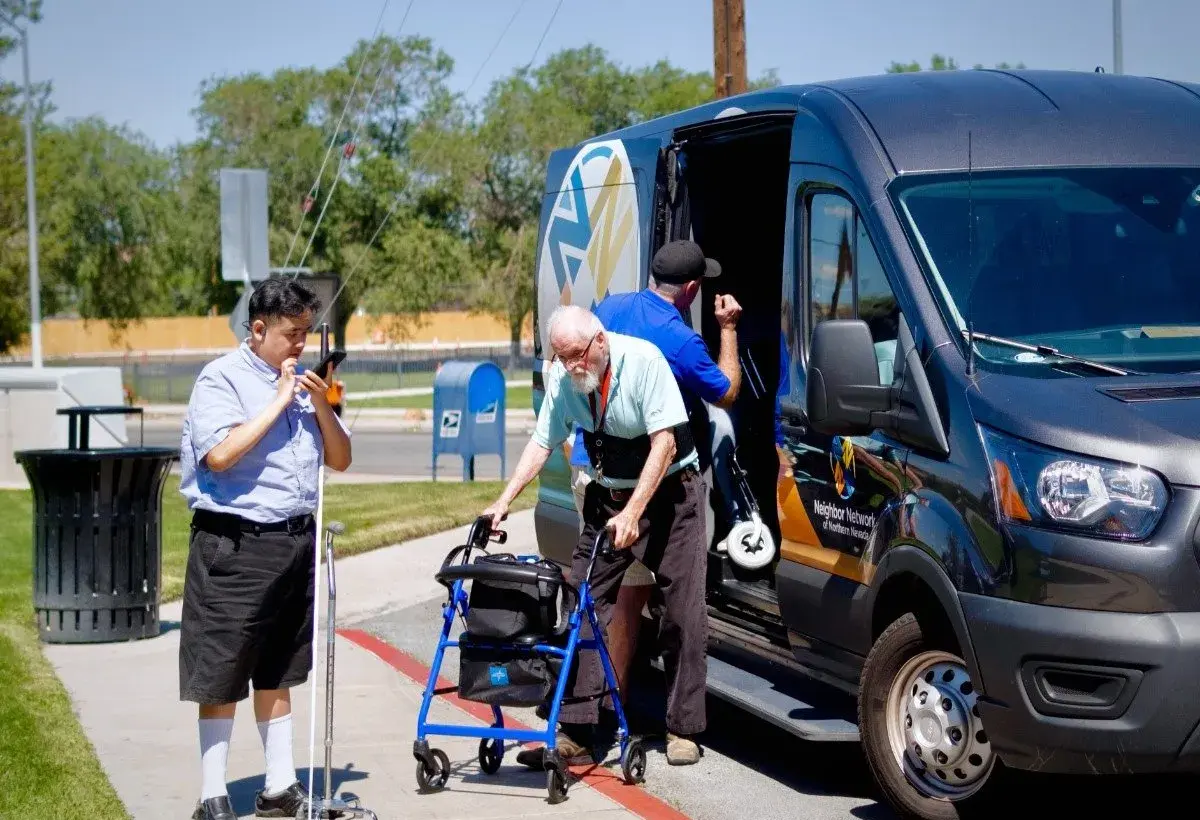
In a second scenario, a resident relies on a local bus service to reach a weekly medical appointment. A vehicle breakdown means the service is cancelled with little notice. Rather than being left to call a helpline or wait and hope, they ask their journey assistant for alternatives. The system checks the local network in real time, including demand-responsive and community transport options alongside fixed-route services, and presents a practical solution that gets the resident to their appointment on time. For operators working to maintain accessibility across fragmented or infrequent networks, this kind of intelligent fallback is precisely what digital transport investment should deliver.
In a third, more forward-looking scenario, an autonomous agent monitors a passenger’s diary overnight. It checks whether travel conditions are likely to affect their morning commute, pre-purchases tickets on an alternative route if conditions deteriorate, and sends a notification only if the recommended departure time needs to change. The passenger wakes up informed, not surprised.
Trust, governance and the operational imperative
Deploying conversational AI in public transport is not simply a user experience decision. Local councils and transport authorities need systems they can stand behind, where recommendations are explainable, data sources are accountable and outputs can be audited. The consequences of a poorly generated route suggestion are not the same in a consumer app as they are in a system deployed on behalf of a local authority to serve vulnerable residents.
This is why the architecture matters as much as the interface. By grounding TripGo Mobility AI in verified routing via the TripGo API, and by using MCP to maintain clear boundaries between what the language model infers and what the routing engine provides, every recommendation is traceable to a real data source. SkedGo’s ISO 27001 certification reflects the same principle applied to information security: scalable AI in transport depends on governance frameworks that give public authorities the confidence to deploy and expand.
The shift from planning to management
The trajectory is clear. Journey planning has always been the starting point, helping passengers understand their options before they travel. But the more meaningful challenge is managing journeys as they unfold: responding to what changes, adapting to individual needs, and providing the kind of contextual, real-time guidance that turns a disrupted journey into a resolved one.
Better disruption management reduces the burden on call centres and frontline staff, improves measurable outcomes for residents who depend on public transport, and makes the case that digital mobility investment delivers genuine public value.
Conversational AI, grounded in live routing data, is the mechanism that makes this possible. It brings together the intelligence to understand intent, the data to assess reality, and the interface to communicate clearly, not just at the planning stage, but throughout the journey itself.
This article was originally published by SkedGo.