A fleet of autonomous and remotely operated marine vehicles will be deployed from the UK’s polar research vessel RRS Sir David Attenborough during a six-week expedition to Greenland.
The mission, which began on 16 July, forms part of the Greenland Ice sheet to AtlaNtic Tipping points (GIANT) research programme led by the British Antarctic Survey (BAS). Researchers will investigate how melting glaciers are interacting with the surrounding ocean and how these changes could influence North Atlantic circulation.
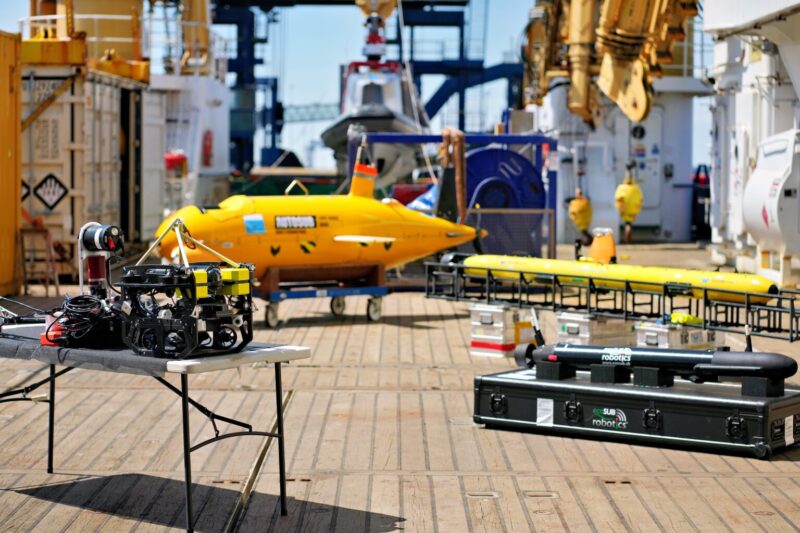
Several autonomous platforms will work alongside RRS Sir David Attenborough, each carrying out different tasks within Greenland’s fjords.
Among them is DriX, an autonomous surface vessel equipped with sonar capable of mapping submerged glacier faces while collecting measurements of ocean temperature, salinity and current strength. The vessel is expected to provide researchers with near real-time observations of changing conditions at the glacier front.
Operating beneath the surface will be teams of Gavia and EcoSub autonomous underwater vehicles. Using acoustic positioning technology, the vehicles will coordinate their movements as they survey submerged glacier faces and collect oceanographic data in areas inaccessible to larger vessels.
Dr Pierre Dutrieux, an oceanographer at British Antarctic Survey who is leading the ocean robotics research on RRS Sir David Attenborough said:If we want to understand how glaciers melt and fracture, we need to be where the action happens – where the glacial ice meets the ocean. We need these ocean robots to do this – the glacier front is so unpredictable and dangerous, because huge blocks of ice calve into the ocean with little warning.
With the fleet of autonomous and remotely controlled instruments we have with us, some of the data we’ll be collecting will be the first of its kind. The DriX will give us a near-live feed of what is happening right at the glacier face – something we wouldn’t have thought possible even a few years ago.
The expedition will also deploy Autosub Long Range, the autonomous underwater vehicle widely known as Boaty McBoatface. Capable of diving to depths of 1,500 metres, the vehicle will travel beneath dense accumulations of floating ice to map underwater geometry and investigate how melting ice influences surrounding ocean conditions.
Another new technology making its field debut is Meltstake, an instrument designed to directly measure melting at the glacier face. Lowered by a remotely operated boat, it drills into submerged ice around 100 metres below the surface to record heat transfer between seawater and glacial ice.
By deploying autonomous and remotely operated systems, researchers can obtain measurements much closer to the ice while reducing risks to personnel.
Dr Kelly Hogan, a marine geophysicist at British Antarctic Survey who is leading the GIANT research project said:We’re in a moment where our tools have finally caught up with our questions. With autonomous vehicles, advanced sensors, and powerful modelling – boosted by AI – we can explore glacier-ocean interactions in ways that were unimaginable just a few years ago.
Researchers also plan to use the findings to support the development of an early warning system capable of identifying periods of rapid glacier change.