AMD has announced that its AMD EPYC processors will now begin powering Kodiak AI’s seventh generation autonomous truck platform in an effort to deliver improved compute performance, processing speed and power efficiency for the Kodiak Driver autonomous driving system.
The announcement marks the first time an autonomous trucking company has implemented advanced EPYC processors into their hardware platform.
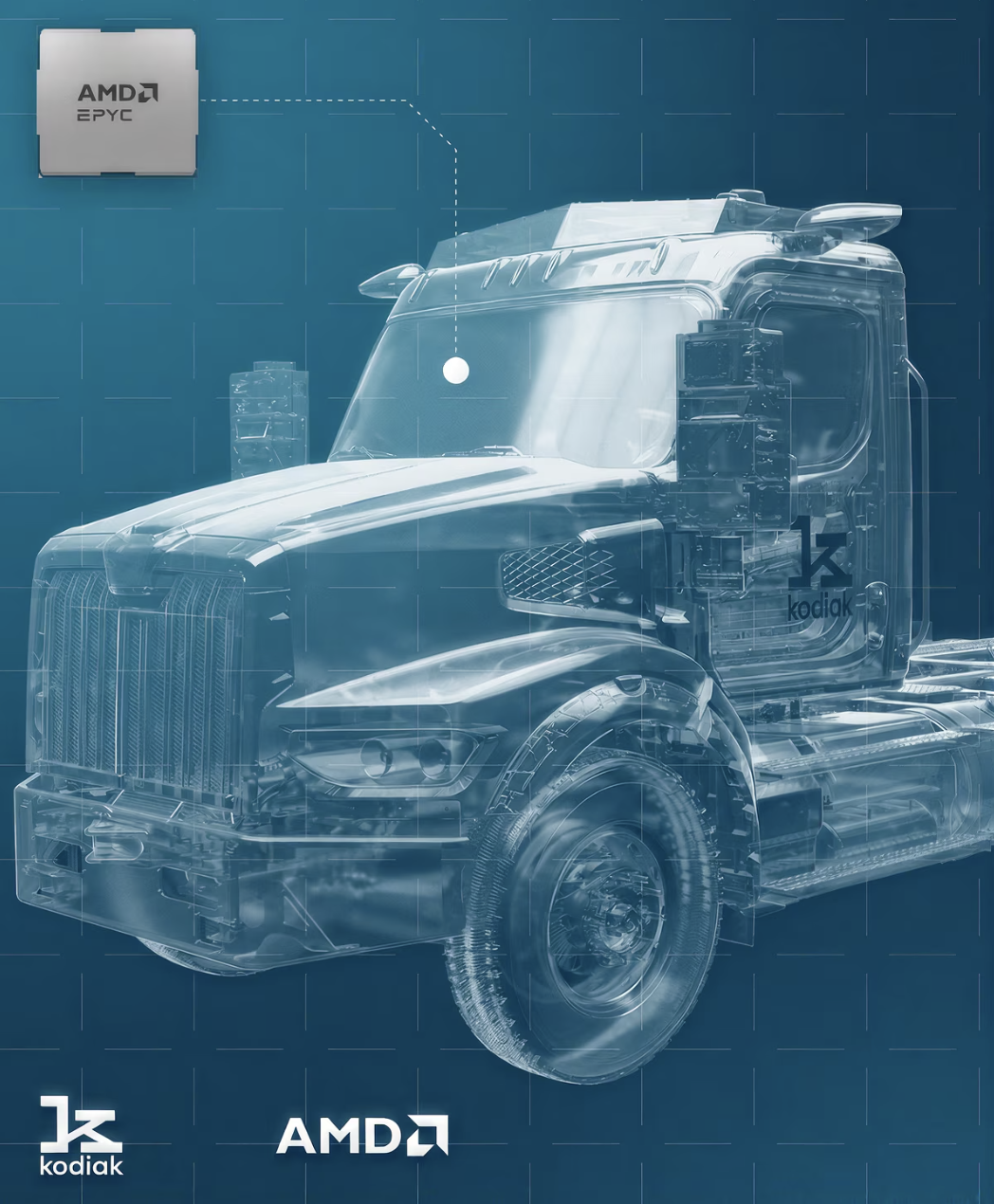
With driverless vehicles incorporating a wide range of sensors (including LiDARs, radars and cameras) in order to detect vehicles, pedestrians, lane lines, roadway signs, and other objects; onboard systems require extremely high processing speeds, as well as high compute performance, in order to perform detection whilst also controlling sensing, thinking, and acting on the road.
Don Burnette, Founder & CEO of Kodiak, said:Autonomous driving requires massive processing capabilities to rapidly handle enormous amounts of sensor data while supporting increasingly sophisticated AI workloads.
AMD EPYC CPUs are the best in the business, delivering the performance, scalability, and efficiency we need to continue advancing the Kodiak Driver and bringing autonomous trucking to commercial scale.
AMD EPYC processors will aim to provide the Kodiak platform with 80 PCIe lanes and high core frequency – 3.15 GHz for base frequency with a max boost frequency of up to 4.4 GHz – delivering 25% higher clock speeds than the previous generation device and enabling Kodiak trucks to process heavy data loads more quickly and support increasingly sophisticated AI workloads for assessing surroundings and reacting in real-time.
AMD EPYC CPUs prioritise path planning, localisation, logistics, and timing-sensitive general-purpose processing to determine vehicle navigation. Large amounts of sensor data from cameras, LiDARs, and radars within Kodiak’s proprietary SensorPods are aggregated in the EPYC processor to be used for preprocessing and path-planning.