The Metropolitan Transportation Authority (MTA) has announced that the first six months of New York City’s congestion relief zone (CRZ) pricing programme has both reduced traffic within the area and raised revenue for the funding of transit improvements across the region.
The programme has also provided a boost for economic activity across New York City since it was activated in Manhattan’s central business district (CBD) on 5 January 2025.
Revenue from the scheme is expected to achieve its initial target of 500 million USD in 2025, enabling the MTA to deliver 15 billion USD worth of critical capital improvements to mass transit on each of its subway, bus, Long Island Rail Road and Metro-North Railroad systems.
Improvements set to be delivered with the new funding include 435 additional R211 subway cars (including 80 additional open-gangway cars), 44 new dual-mode locomotives for the Long Island Rail Road, 300 new M9A cars for Metro-North and the Long Island Rail-Road and Communications Based Train Control (CBTC) signal upgrades on the A and C lines between Downtown Brooklyn and Ozone Park, enabling more frequent and reliable service.
Additional improvements are set to include Americans with Disabilities Act (ADA) upgrades at 23 subway stations, including new elevators, reconstructed platforms, and other improvements, and the commencement of the tunnelling contract for Phase 2 of the Second Avenue Subway, which will be awarded in the second half of 2025.
Governor Hochul said, said:Six months in, it’s clear: congestion pricing has been a huge success, making life in New York better.
In New York, we dare to do big things, and this program represents just that - traffic is down throughout the region, business is booming, transit ridership is up, and we are making historic upgrades to our transit system. We’ve also fended off five months of unlawful attempts from the federal government to unwind this successful program and will keep fighting - and winning - in the courts. The cameras are staying on.
The system came under fire from United States Secretary of Transportation Sean P. Duffy this April, who criticised the programme’s operation, citing its ‘unprecedented scope’ as reason for its immediate termination.
New York State and the MTA have confirmed that, thus far, the parties have successfully fought off a number of legal challenges launched by the United States Department of Transportation (USDOT) and the Trump Administration to terminate the programme, with a preliminary injunction issued in May in the case of Metropolitan Transportation Authority v. Duffy, keeping congestion pricing in effect pending further court proceedings.
MTA Chair and CEO Janno Lieber said:Congestion relief is a massive success and validation of the initiative keeps pouring in. The program is achieving all of its goals in terms of traffic reduction, increased travel speeds, safety, noise reduction and more. And not only is Congestion Relief delivering all the projected benefits – and more – it’s also proving that New York State government can effectively execute major, ambitious initiatives that improve the quality of life in ways New Yorkers notice and appreciate.
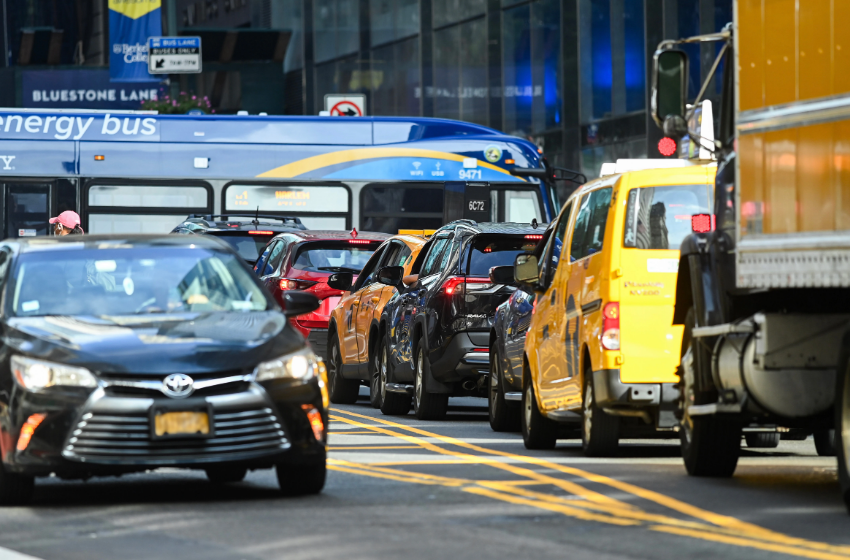
Since its activation in January, the programme has reduced traffic throughout the region, with the total number of vehicles entering the zone having decreased by 11% since its inception (67,000 fewer per day, more than 10 million fewer when compared to the same time frame in 2024).
Traffic delays within the CRZ are down by 25% and 9% across the entirety of the metropolitan region. Delays have been reduced by 10% across the Bronx and 14% in select parts of Bergen County, New Jersey. Time lost to traffic jams has been driven down by 12%, reinstating seven minutes for every hour spent in traffic during 2024.
River crossing travel times have decreased by 6% to as much as 42% in 2025 when compared to 2024, with rush hour delays in the Holland Tunnel down by 65% and Lincoln Tunnel’s MTA express buses travelling nearly 24% faster than in 2024. Roads and highways leading to the CRZ itself are also moving faster when compared to the same time period in 2024.
Crashes across the CRZ are down 14%, traffic injuries have reduced by 15% and pedestrian fatalities within New York City have now matched levels last seen in 2018.
Air quality & noise pollution have also improved, with honking and vehicle noise complaints down by 45% in 2025 and a new report from the City Department of Health and Mental Hygiene released on 2 July showing steady or decreasing levels of fine particle air pollution (or PM2.5) at a majority of sites both inside and outside the Congestion Relief Zone.
Transit ridership has increased across all modes of transport between January and May 2025 when compared to the same time period in 2024. All MTA modes of public transportation seeing record high ridership during the first half of the year, with subway ridership increasing by 7%, bus by 12%, Metro-North by 6% and Access-A-Ride by 21%.
Services themselves have also seen large improvements, with subway on-time performance in May rising to 85.2%, the best non-pandemic month in record history, and Long Island Rail Road and Metro-North On-Time Performance rising to a consistent 97% and 98% respectively in 2025.
Bus speeds have increased by an average 3.2% within the CRZ, with a number of select routes increasing by 25%, with service also increased across eight key Express Bus routes in March and on 14 high-ridership local bus routes on 29 June.
The MTA also launched the first phase of the Queens Bus Network Redesign on the same date, with the second phase due to begin on 31 August.
With improvements to traffic and reduced gridlock, business district pedestrian activity within the CRZ increased by 8.4% over last year, a stronger number than that of the growth outside the area (2.7%).