Waymo has announced the start of fully autonomous operations using its sixth-generation Waymo Driver, paving the way to expand its services to additional cities.
The system has been developed to reduce operational costs while maintaining the company’s established safety standards and to support multiple vehicle platforms across a range of environments, including areas with severe winter weather.
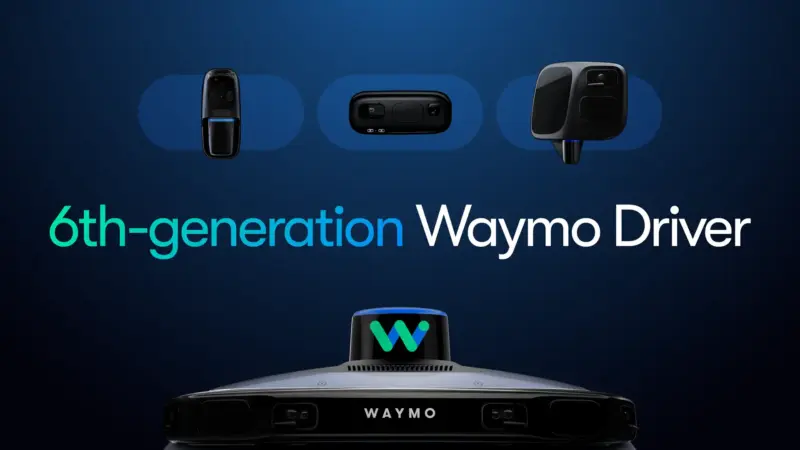
The sixth-generation Waymo Driver builds on seven years of experience, during which the company’s autonomous vehicles logged nearly 200 million miles across the central areas of more than ten major cities, as well as extensive freeway networks. The system uses a combination of high-resolution cameras, lidar, and radar in a unified sensor suite, allowing it to respond to rare, complex driving situations that occur over millions of miles of road testing.
Vision System
The Waymo Driver’s vision system operates with higher resolution than standard automotive cameras and is designed to maintain visibility in low-light conditions or glare. The core of the system is a 17-megapixel sensor capable of capturing detailed images while remaining stable under varying temperatures. Integrated cleaning systems help maintain camera visibility in adverse weather, while radar and lidar provide backup when visual sensors are limited.
Lidar
The system’s lidar generates 3D point cloud images of the surrounding environment, which aids in detecting smaller objects near larger ones. The sixth-generation lidar leverages recent reductions in industry costs and incorporates custom chips and optical designs to provide longer-range detection with improved reliability. Short-range lidar sensors supplement the cameras to ensure precise distance measurements in urban situations.
Radar
Waymo’s imaging radar provides continuous tracking of object distance, speed, and size, even in poor weather. The latest generation uses in-house algorithms to improve performance in rain or snow and works in combination with other sensors to enhance overall situational awareness.
External Audio Receivers
External audio receivers (EARs) are used to detect critical sounds, such as sirens or railroad crossings. Positioned around the vehicle’s perception dome, EARs help localise sounds and reduce interference from wind, providing the system with additional cues to respond appropriately to its surroundings.
Multi-Platform Deployment
The Waymo Driver is designed as an adaptable system that can be deployed across different vehicle platforms, including the Ojai and Hyundai IONIQ 5. The approach supports high-volume production and allows the company to expand its autonomous service efficiently.