New Freedom of Information (FOI) data researched by Geotab, a global leader in connected transportation solutions, has revealed a striking divide in electric vehicle adoption across government bodies in the major UK cities.
The data, obtained from FOI requests submitted to seven UK city councils and Transport for London (TfL), shows wide disparities in the percentage of electric vehicles in local authority fleets.

Bristol leads the way, with EVs making up 44.5% of its vehicle fleet, while Liverpool follows closely behind with 43.3%. Leeds ranked third (27.8%), followed by Manchester (26.8%) and Glasgow (25.8%). Data revealed by Transport for London revealed a stark contrast, with just 3.2% of its fleet of HGVs and vans being electric, showing a wide variation in the share of EVs across the major cities.
The Geotab analysis highlighted that no city councils reported any use of fuel-cell electric vehicles in their fleets, while plug-in hybrid electric vehicles made up less than 1% of all city fleets. Liverpool reported the highest uptake of hybrid-electric vehicles (29.5%), followed by Bristol (20%).
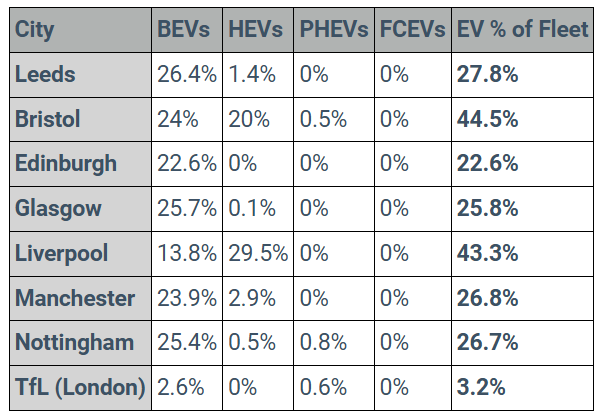
The overall findings a fragmented approach to local authority fleet decarbonisation. While some cities are keeping pace with the electrification rollout, others are moving more slowly, despite the UK’s 2030 ban on new petrol and diesel vans looming. The uneven progression risks creating an electrification divide, leading to implications for climate targets, air quality and public service delivery.
The divide also highlights more than just different decarbonisation speeds; it represents a significant gap in operational and financial efficiency. For many fleets, the transition to electric is a win-win for both business and the environment. A study by Geotab in 2024 – Taking Charge – On the road to the EV future – reviewed how EVs can transform fleets, using data from more than 1.3m vehicles. The report showed that over a projected 7-year lifespan of a vehicle, the savings on switching from an internal combustion engine (ICE) to an EV could potentially save an average of over £10,000 per vehicle. The research revealed by the FOI requests suggests that some fleets are not only falling behind on their climate goals by delaying the transition, but they may also be missing out on substantial financial benefits.
Why Data-Driven Fleet Management Matters
The transition is not just about replacing internal combustion engine vehicles with EVs. For large city fleets operating in built-up urban areas, especially those supporting last-mile logistics and essential public services, the use of telematics, route optimisation and predictive maintenance will be key.
Scaling up to 100% EV adoption can still present a significant operational challenge, but fleets do not need to make the switch all at once to start noticing the benefits. With UK fleets increasingly adopting telematics, real-time data and analytics can be used to identify the best routes and duty cycles to electrify first. Even partial electrification can deliver significant gains, from reducing vehicle downtime and cutting emissions in areas with the greatest air quality challenges, to lowering operating costs and better planning charging infrastructure to match operational needs.
Aaron Jarvis, Associate Vice President for Geotab EMEA, said:Electrifying fleets at scale can be a difficult challenge, especially for city councils that will need to ensure they have the necessary charging infrastructure in place to support these vehicles. Progress across the board is uneven, and many fleets will risk falling short of the targets needed to decarbonise urban city transport.
That said, it’s positive to see some of the early movers in the UK setting the benchmark for what’s possible as we make the transition to net zero. We’re seeing more fleets adopt data-driven fleet management, which is an encouraging sign that operators are placing high priority on the transition to net zero. Tools like fleet telematics can make the difference in optimising route planning, performance monitoring and cutting unnecessary emissions from practices like idling.
The key isn’t aiming for 100% EV overnight, but taking pragmatic, data-driven steps: identifying which vehicles to electrify first, optimising routes and reducing unnecessary emissions. Combining these insights with a clear commitment to electrification will allow councils to make faster, smarter progress, while supporting the last-mile transition in dense urban areas.
This article was originally published by Geotab.