Fully electric trucks from MAN Truck & Bus have now collectively covered more than five million kilometres in daily operations across Europe.
Since early 2025, around 200 pre-series MAN eTGX and eTGS vehicles have been in service with major logistics companies, including DB Schenker, Dachser, Duvenbeck and Dräxlmaier.
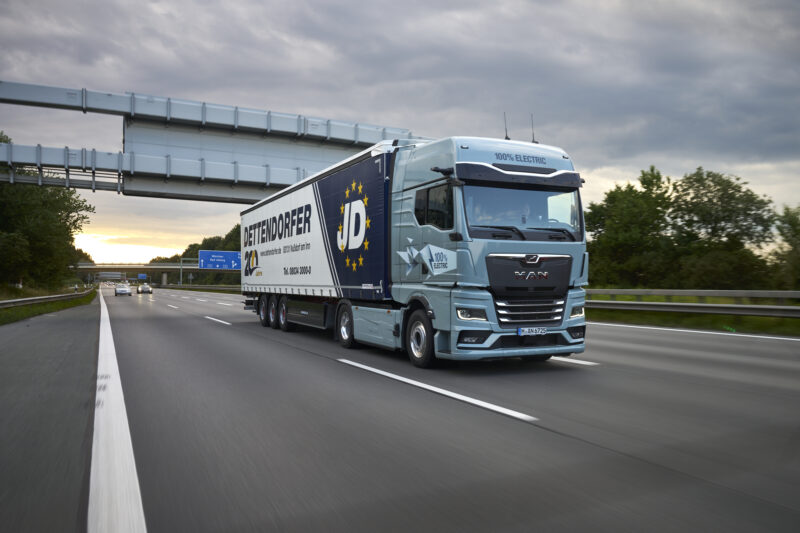
According to MAN, the vehicles have demonstrated reliable performance in real-world conditions. Running exclusively on renewable electricity, the fleet has achieved an average energy consumption of 90 kWh per 100 kilometres. Compared with diesel trucks consuming about 27 litres per 100 kilometres, the company estimates that these electric vehicles have saved approximately 3,600 tonnes of CO₂ to date.
If each of the trucks reaches a lifetime mileage of 1.2 million kilometres, total carbon savings could amount to around 172,000 tonnes, equivalent to the annual emissions of a German city with about 32,000 inhabitants.
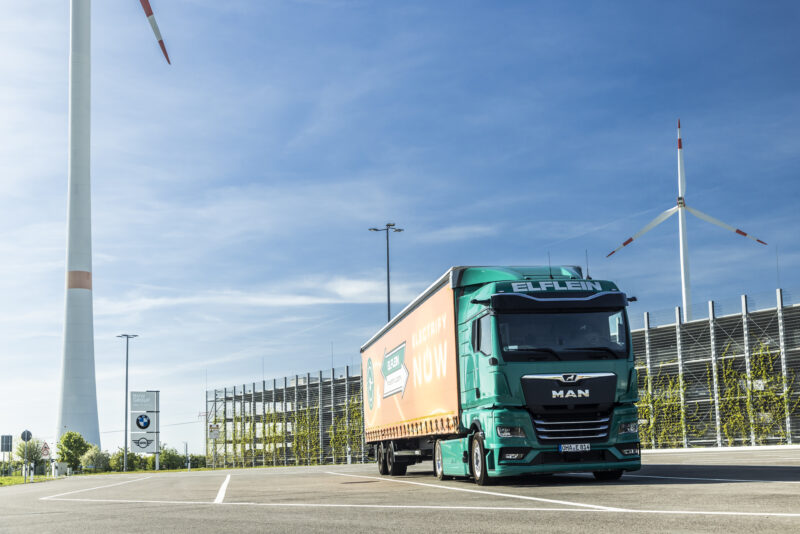
Series production of the MAN eTGX and eTGS began in June 2025 at the company’s Munich plant. The facility operates a mixed production line capable of assembling both diesel and electric trucks, with a maximum output of up to 100 vehicles per day.
Customer interest has grown rapidly. By mid-2025, MAN reported nearly 800 heavy-duty electric trucks on order, approaching its target of surpassing 1,000 orders by the end of the year. In the first half of 2025, sales of electric vehicles rose by 238 percent compared with the same period in 2024, albeit from a relatively low base.
Friedrich Baumann, Executive Board Member for Sales and Customer Solutions at MAN Truck & Bus, said:The five million kilometres covered in customer use are impressive proof of the practical suitability of our MAN eTrucks. Whether in automotive, timber or food logistics, the versatility of the vehicles is convincing across all industries. With our series production, we are now broadening this strength and providing our customers with the best solutions for sustainable road freight transport.
A growing number of companies in Europe are incorporating MAN eTrucks into their fleets. The Behrens Group in Germany has deployed eTGX vehicles in timber transport, integrating them with swappable bodies for electric forklifts and charging them partly with on-site photovoltaic power.
In France, Jacky Perrenot has placed an order for over 100 eTrucks to support food distribution, while Dutch firms Cornelissen, van Doorn and Koopman are introducing the vehicles for regional and urban deliveries. Danone in Poland is using MAN eTrucks for food logistics, and Portuguese freight forwarder TJA has added vehicles for national operations.
Adoption extends into northern Europe as well, with Nor Tekstil in Norway and Royal Unibrew in Denmark both starting to use MAN eTrucks for textiles and beverage distribution respectively. In Austria, a municipal consortium representing 12 cities and towns has agreed a framework contract for up to 45 vehicles.