A research team at Loughborough University has been conducting a series of tests to assess how passengers respond when self-driving vehicles ‘go wrong’.
The team has been using immersive virtual reality (VR) technology to explore how people respond to various emergencies during autonomous trips in order to help the Department for Transport (DfT) and the Government’s Centre for Connected and Autonomous Vehicles (CCAV) understand how future self-driving taxis should be designed to keep passengers with different needs safe and supported in emergencies.
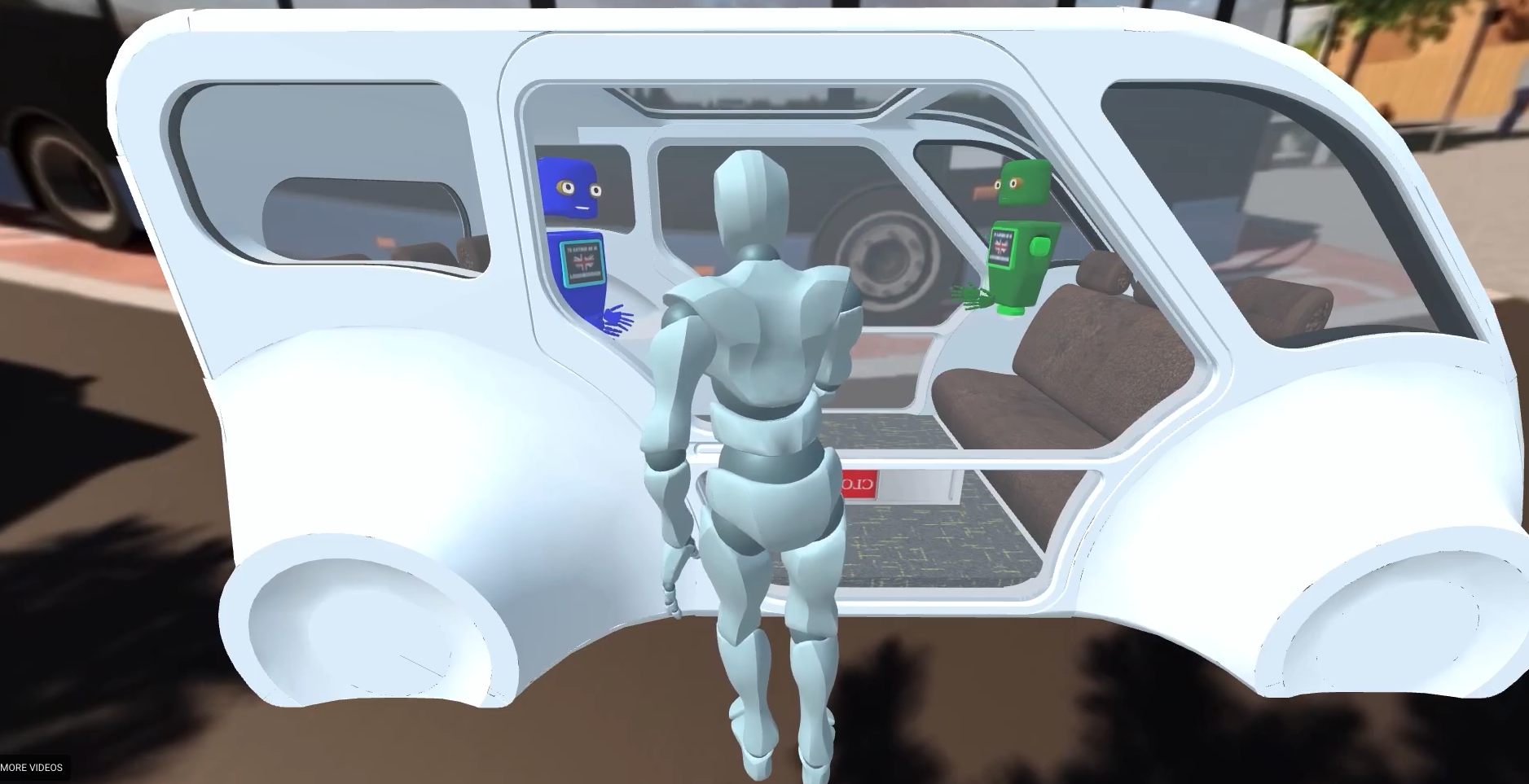
A series of simulations place participants together as avatars inside a self-driving taxi during emergency situations, with the team at Loughborough then directly observing how people respond when there is no human present.
91% of people with a range of protected characteristics under the Equality Act 2010 (including 81 adults and 10 children aged eight to 17) experienced the same scenarios wearing VR headsets. They were then asked what actions they might take, what information or features they feel would help manage the situation, and how safe they felt during each simulated scenario.
Professor Burnett said:Participants experienced scenarios including a medical emergency involving another passenger, a fire inside the vehicle, flooding on the route, a collision, and a pedestrian attempting to open the taxi door.
By using VR, researchers were able to safely recreate high-risk situations that would be impossible to test in the real world, while still capturing authentic emotional and behavioural responses.
Results from the tests, which were funded by the Department for Transport, have now been published in an online report, with findings highlighting that barriers during emergencies are both practical and shaped by how safe people feel, with gender, age, disability and other protected characteristics influencing how confidently passengers are able to act or seek help.
Researchers at Loughborough have also contributed to a second DfT and CCAV-funded project alongside the main project, which examines which non-driving activities people can safely carry out while a self-driving vehicle is driving itself, without compromising their ability to take back control when required to by the automated system.
This research, which was carried out in collaboration with the University College London, involved 87 participants taking part in a series of controlled driving simulator trials. During periods of self-driving; participants were asked to complete a number of everyday non-driving related activities, such as watching videos, reading, completing puzzles, eating or drinking – before receiving a prompt to take back control of the vehicle.
Take-back control was assessed by examining how swiftly and safely participants resumed control, including whether or not they regained situational awareness by scanning both mirrors and road conditions before starting driving, as well as their steering, braking and lane-keeping performance once manual control resumed.
To carry out the tests; a person sits behind the wheel of the Loughborough University driving simulator, which was used to explore which non-driving activities people can safely carry out whilst a self-driving vehicle is driving itself without compromising their ability to take back control when required.
These findings have also been published in an online report, which show that taking back control quickly does not always mean taking back control safely, with some activities affecting how well participants were able to rebuild awareness of their surroundings before resuming driving.
Dr Mutzenich said:We found that some non-driving related activities, such as eating and drinking, were relatively easy for participants to disengage from after a takeover request. Others, however, proved much harder. In some cases, participants continued mobile phone tasks, like watching a film, even after starting manual driving.
We also observed that very few participants looked in their mirrors before taking control, which is a crucial element of understanding the driving environment.
Phase 2 of this research is now underway, and the focus is on testing clearer guidance for users-in-charge on what constitutes a safe and effective takeover.