Daimler Truck has presented the Mercedes-Benz NextGenH2 Truck, a hydrogen fuel cell vehicle planned for limited customer deployment from the end of 2026.
A small series of 100 vehicles will be produced at the Mercedes-Benz plant in Wörth, Germany, and used by selected customers in long-haul transport.
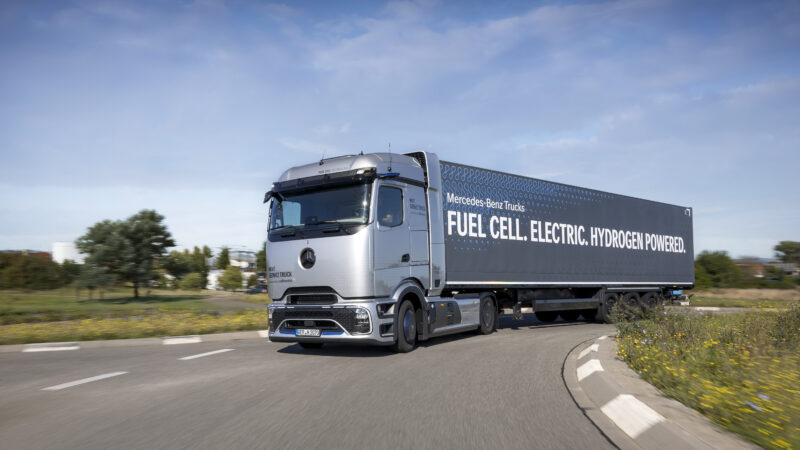
The NextGenH2 Truck builds on the earlier GenH2 prototype and continues to use liquid hydrogen as its energy source. This approach allows long driving ranges while maintaining payload capacity comparable with conventional diesel trucks. The vehicle is designed for demanding heavy-duty operations and a wide range of standard semi-trailers.
Power is provided by a twin fuel cell system supplied by cellcentric, the Daimler Truck and Volvo Group joint venture. Two BZA150 fuel cell units deliver a combined output of 300 kW, working alongside a buffer battery to supply electricity to the integrated e-axle. The only exhaust emission from the fuel cell system is water vapour.
Several components are shared with the battery-electric Mercedes-Benz eActros 600, including the aerodynamically optimised ProCabin, the electric drive axle, the Multimedia Cockpit Interactive 2 and current driver assistance and safety systems. The revised design improves efficiency and vehicle integration while supporting series-level technology.
Liquid hydrogen is stored in two tanks with a combined capacity of up to 85 kg. Refuelling is designed to take around 10 to 15 minutes. Daimler Truck states that liquid hydrogen offers advantages in energy density, vehicle weight and transport costs compared with compressed gaseous hydrogen.
The NextGenH2 Truck also features a more compact layout behind the cab, enabling a shorter wheelbase and greater compatibility with different trailer configurations within EU length limits. Additional safety measures include hydrogen leak detection, improved tank protection and systems that allow overnight stays in the cab.
Prototypes have already undergone testing in a range of conditions, including alpine environments. The development and initial deployment of the trucks are supported by public funding from German federal and regional authorities. Daimler Truck plans to introduce fuel cell trucks into series production in the early 2030s.