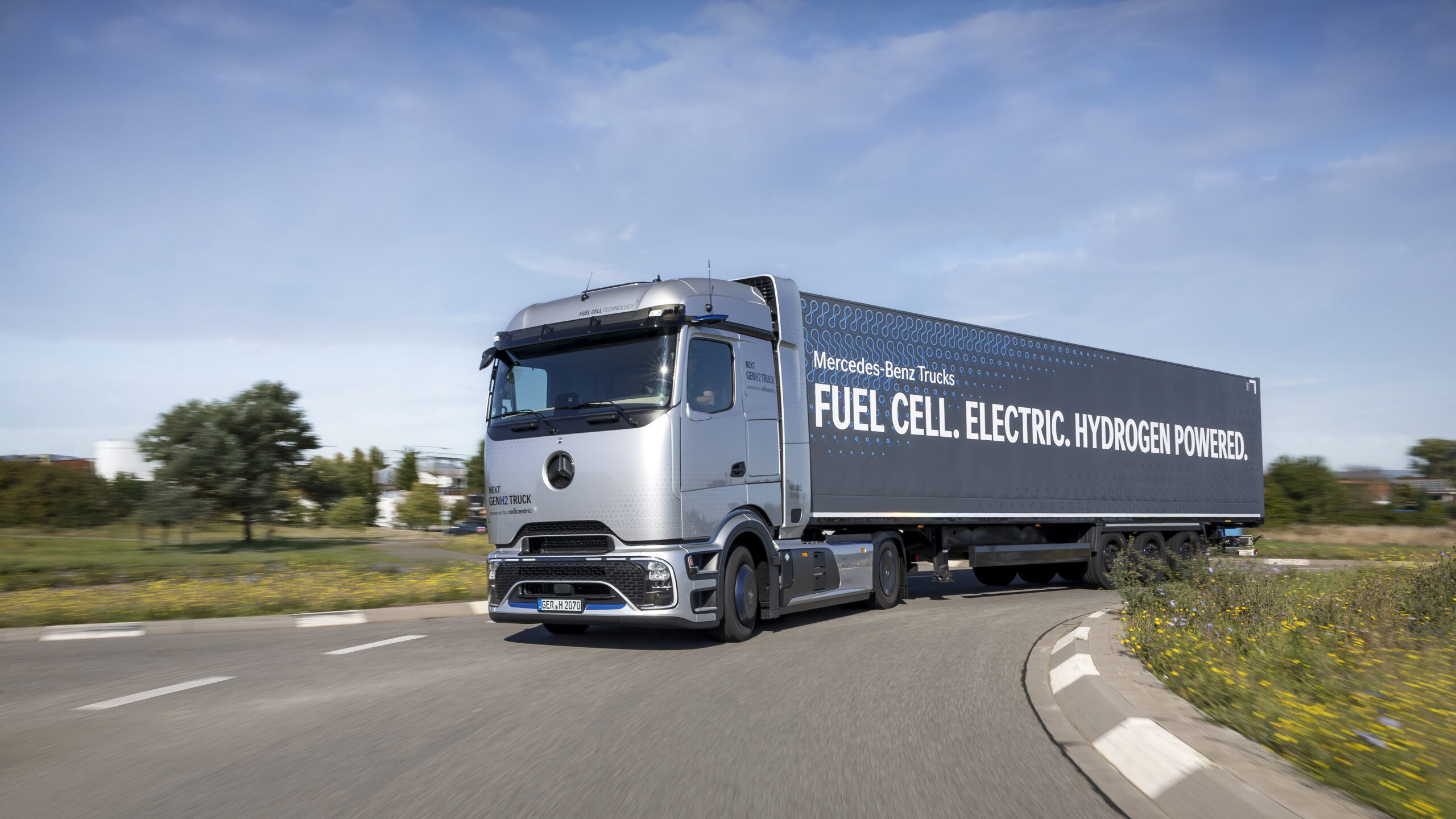
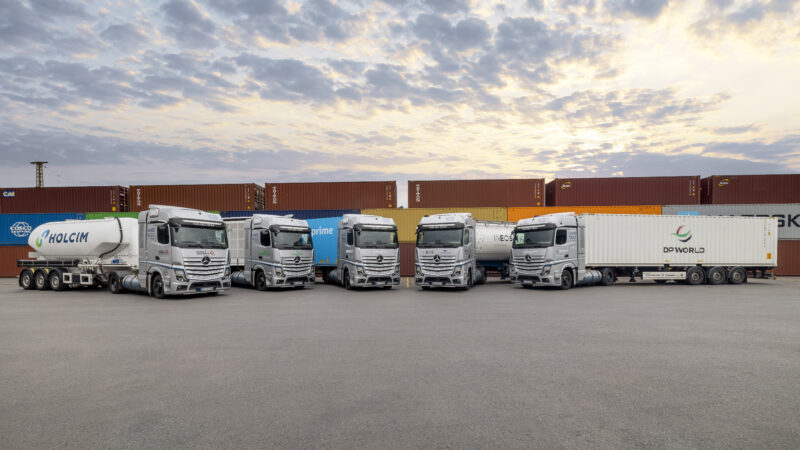
Daimler Truck has reported the completion of more than 225,000 kilometres of real-world operations with five Mercedes-Benz GenH2 fuel cell trucks.
The vehicles were deployed in Germany by Air Products, Amazon, Holcim, INEOS Inovyn, and Wiedmann & Winz as part of initial customer trials that began in July 2024.
The trucks, developed with fuel cell systems from cellcentric, were tested in daily logistics operations across a variety of applications, from transporting building materials to handling containers and chemicals.
Over the trial period, average hydrogen consumption ranged between 5.6 kg and 8 kg per 100 kilometres, depending on load and route, with an average gross vehicle weight of 16–34 tonnes.
In total, 285 refuellings were carried out using around 15 tonnes of liquid hydrogen at facilities in Wörth am Rhein and Duisburg. The choice of liquid hydrogen was aimed at achieving longer ranges, with the vehicles demonstrating the capability for distances of more than 1,000 kilometres on a single refuelling.
Michael Scheib, Head of Entire Vehicle Development at Mercedes-Benz Trucks, said:The initial customer trials are extremely valuable for the further development of our fuel cell trucks. By deploying the GenH2 Trucks in real-world logistics operations, we have been able to demonstrate their performance, reliability and efficiency across various transport applications and gain important insights. This enables us to refine the technology and vehicles according to the specific needs of our customers all the way to series production.
Furthermore, the intensive use of the liquid hydrogen fueling stations during the trials enables further optimization of the refueling process. All these practical experiences also help us to optimally prepare our sales and service for the deployment of hydrogen trucks for our customers.
Customers reported that the GenH2 Trucks could be deployed in a manner comparable to diesel vehicles, noting long range, refuelling times of around 10–15 minutes, and suitability for long-distance operations. Feedback highlighted comfort, low noise levels, and reliability during daily use.
Each participating company applied the vehicles to different tasks:
- Amazon tested a fixed logistics route between Frankenthal and Sindelfingen
- Air Products used the truck for bottled gas deliveries
- Wiedmann & Winz, in cooperation with DP World, deployed the truck in combined transport involving container haulage
- Holcim operated the truck in cement transport across Germany and into the Netherlands
- INEOS Inovyn’s partner VERVAEKE used the truck for PVC and vinyl distribution
Servicing during the trials was supported by Daimler Truck through specialised service branches in Haan and Stuttgart-Feuerbach. Customers emphasised the importance of close technical support and training during the trial phase.
Daimler Truck plans to begin a second trial phase in late 2025 with five additional customers. Meanwhile, development of the next generation of GenH2 trucks is underway, with small-series production of 100 units scheduled to begin in 2026 at the Wörth plant.