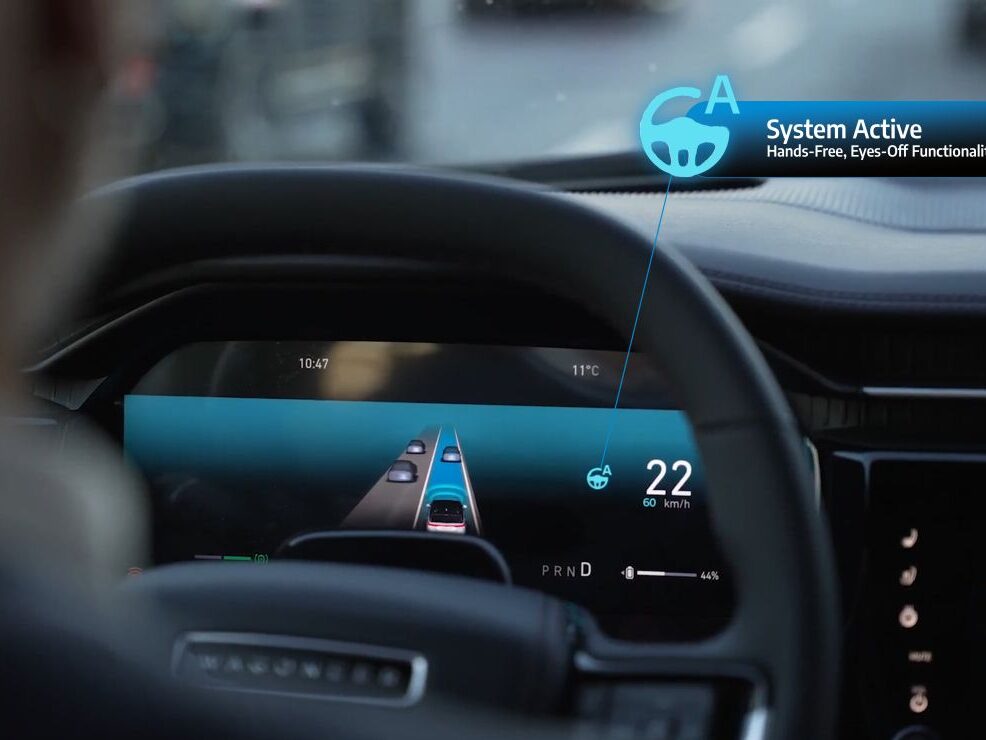
This week, InCabin and AutoSens Europe showcased a wave of innovations that are shaping the future of automotive safety, connectivity, and perception. From in-cabin monitoring to advanced sensor fusion and high-speed data networks, the events highlighted how AI, multi-modal sensing, and simulation are accelerating the shift toward autonomous, connected, and software-defined vehicles.
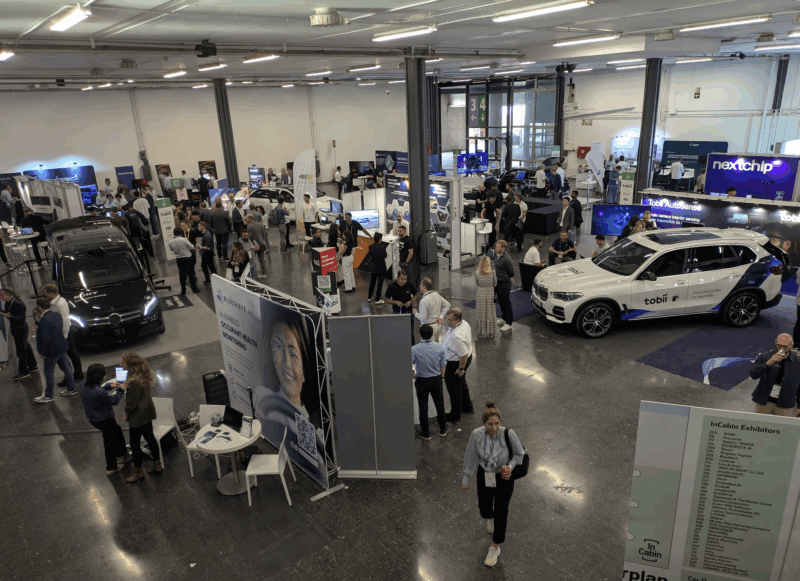
Smarter, Safer Interiors
This year’s events included a clear focus on in-cabin safety. For example, Anyverse, in collaboration with Euro NCAP, is pioneering the use of high-fidelity synthetic data to evaluate driver state, occupant, and child presence monitoring systems. By simulating complex scenarios that are difficult to replicate physically, the approach promises more consistent, comprehensive testing while helping OEMs bring safer vehicles to market faster.
Victor Gonzalez, CEO of Anyverse said:Euro NCAP’s mission is to assess safety systems against rigorous criteria; our role is to support that mission with tools that extend coverage,” said. “Synthetic data lets us probe conditions that are difficult to stage physically, so Euro NCAP can study the full picture of in-cabin system behavior with greater repeatability and control. We’re proud to contribute our technology and
know-how to this research effort.
Complementing these advances, Sightic has received ethical approval to collect data from up to 5,000 drivers, creating the world’s largest real-world study on alcohol and drug impairment. The scale of this study sets a new benchmark for ethically sourced data to train AI systems that monitor driver alertness and improve road safety.
In-Cabin Sensor Technologies
The in-cabin monitoring landscape is evolving rapidly, with multi-modal sensing emerging as the key to robust occupant safety. At InCabin, LIPS Corporation showcased its LIPSedge® T225/T235 3D ToF cameras paired with the LIPSense™ Body Pose 7.1.0 AI engine, enabling real-time detection of driver fatigue, gaze, posture, and child presence.
In addition, pushing the boundaries of sensor fusion, Tobii Autosense, HTEC, and D3 Embedded demonstrated the first solution combining a single camera and mmWave radar on Texas Instruments’ Jacinto™ 7 platform. This system tracks vital signs, occupant presence, and intrusions, even under low-light or obstructed conditions. This technology highlights how camera and radar fusion can handle edge cases that single sensors struggle with.
Henrik Mawby, Head of Ecosystem and Partnerships Tobii Autosense, at Tobii said:This achievement reflects true collaboration across complementary domains of expertise. Together with HTEC and D3 Embedded, we’ve been able to fuse camera and radar in a way the industry hasn’t seen before, delivering safer and more cost-efficient interior sensing to help automakers meet tomorrow’s safety standards.
Also in partnership with Texas Instruments, Rheinmetall Dermalog SensorTec emphasised efficiency with a two-sensor in-cabin system that meets NCAP 29 requirements while providing adaptive airbag suppression. The company presented an efficient, high-performance in-cabin monitoring system that enhances occupant safety while minimising hardware complexity. The solution is designed to combine camera and radar sensors with advanced software, achieving full interior monitoring with just two sensors. This monitors occupants for safety and comfort, while optimising cost.
Meanwhile, LITEON Technology showcased AI-powered vision software that fuses in-cabin monitoring with environmental sensing. The system tracks driver gaze, fatigue, and physiological signals like heart rate, while simultaneously assessing external hazards to enhance collision avoidance. Designed for seamless integration into existing ADAS platforms, it provides real-time insights without additional hardware, offering a scalable, cost-effective solution that improves both driver safety and overall vehicle intelligence.
In parallel, Brighter Signals and Jiangsu Changshu Automotive Trim Group (CAIP) announced large-scale production of tactile fabric sensors for seats. These sensors capture force, movement, and proximity in real time, combining occupant safety, intelligent interiors, and sustainability.
Andrew Klein, CEO of Brighter Signals B.V., said:This partnership with CAIP is a major step forward in our mission to bring tactile sensing into every car and every factory. CAIP’s global manufacturing footprint and deep expertise in automotive systems will help us scale production rapidly and deliver our technology to OEMs worldwide. Together, we are enabling safer, more intelligent and more sustainable mobility - and driving the next wave of industrial automation.
Together, these innovations illustrate a trend toward multi-modal, AI-driven in-cabin sensing, where a range of technologies work in concert to provide safer, more responsive interiors.
Exterior Sensing, Data Connectivity, and Simulation
Beyond the cabin, manufacturers are tackling the challenge of high-speed data handling and efficient perception systems. Axonne Inc. introduced the Cyton™ Multi-Gigabit Ethernet Transceiver, Bridge, and Media Converter, enabling low-latency, secure communication between cameras, sensors, and processors—a critical capability for autonomous and software-defined vehicles.
Meanwhile, intoPIX, in partnership with Lattice Semiconductor, demonstrated TicoRAW and JPEG XS compression for automotive vision. By reducing bandwidth, latency, and power consumption, these solutions make multi-sensor AI pipelines more efficient and scalable, helping OEMs manage the growing data demands of autonomous driving.
Simulation and virtual testing are also reshaping sensor development. Sony Semiconductor Solutions leveraged rFpro’s AV elevate platform to showcase next-generation ADAS and AV camera sensors virtually, allowing engineers to train and validate perception systems without physical prototypes.
Finally, OpenGMSL, an open standard for high-speed, low-latency automotive communication, announced new members, including Sony Semiconductor Solutions and Valeo, reflecting industry-wide efforts to standardise ADAS and infotainment connectivity for faster deployment and global interoperability.
Paul Fernando, President of the OpenGMSL Association said:The response we’re seeing underscores the industry’s desire for an open standard based on a globally adopted technology. OpenGMSL uniquely addresses the needs of both ADAS and infotainment systems, delivering a scalable and future-proof standard that OEMs, Tier 1s, and technology partners require.
Key Takeaways
Several key trends emerged from these events:
- Multi-modal sensing now dominates in-cabin monitoring, combining cameras, radar, tactile sensors, and AI to improve occupant safety
- Ethically sourced and synthetic data are critical for robust, unbiased AI systems
- High-speed, low-latency connectivity and compression technologies are essential for real-time sensor data handling
- Simulation and virtual testing accelerate development and reduce reliance on physical prototypes
- Collaboration across OEMs, Tier-1s, and technology providers is accelerating innovation and deployment
Overall, as vehicles become increasingly intelligent, connected, and software-defined, the innovations unveiled at InCabin Europe and AutoSens Europe 2025 demonstrate the industry’s commitment to safer, smarter, and more responsive mobility.
Read more from AutoSens and InCabin:
- A Decade of Automotive Technology: Sensors, Systems, and the Road Ahead
- Why Every Robotaxi Needs a Backseat Driver
- Public Confidence and Comprehension in Automotive Technology